- InstaByte
- Posts
- Anthropic caused 'SaaSpocalypse'
Anthropic caused 'SaaSpocalypse'
ALSO: Data Partitioning vs Sharding

InstaByte
February 11, 2026
In partnership with


Welcome back!
This week's coding challenge tackles a classic interview problem that has challenged generations of programmers. Let’s see if you can solve it.
Today we will cover:
Search a 2D Matrix
Data Partitioning vs Sharding
Read time: under 4 minutes
CODING CHALLENGE
Search a 2D Matrix
You are given an m x n integer matrix called matrix with the following two properties:
Each row is sorted in non-decreasing order.
The first integer of each row is greater than the last integer of the previous row.
Given an integer target, return true if target is in matrix or false otherwise.
You must write a solution in O(log(m * n)) time complexity.
Example 1:

Input: matrix = [[1,3,5,7],[10,11,16,20],[23,30,34,60]], target = 3
Output: true
Example 2:

Input: matrix = [[1,3,5,7],[10,11,16,20],[23,30,34,60]], target = 13
Output: false
Solve the problem here before reading the solution.
PRESENTED BY CODE

Tech moves fast, but you're still playing catch-up?
That's exactly why 100K+ engineers working at Google, Meta, and Apple read The Code twice a week.
Here's what you get:
Curated tech news that shapes your career - Filtered from thousands of sources so you know what's coming 6 months early.
Practical resources you can use immediately - Real tutorials and tools that solve actual engineering problems.
Research papers and insights decoded - We break down complex tech so you understand what matters.
All delivered twice a week in just 2 short emails.
SOLUTION
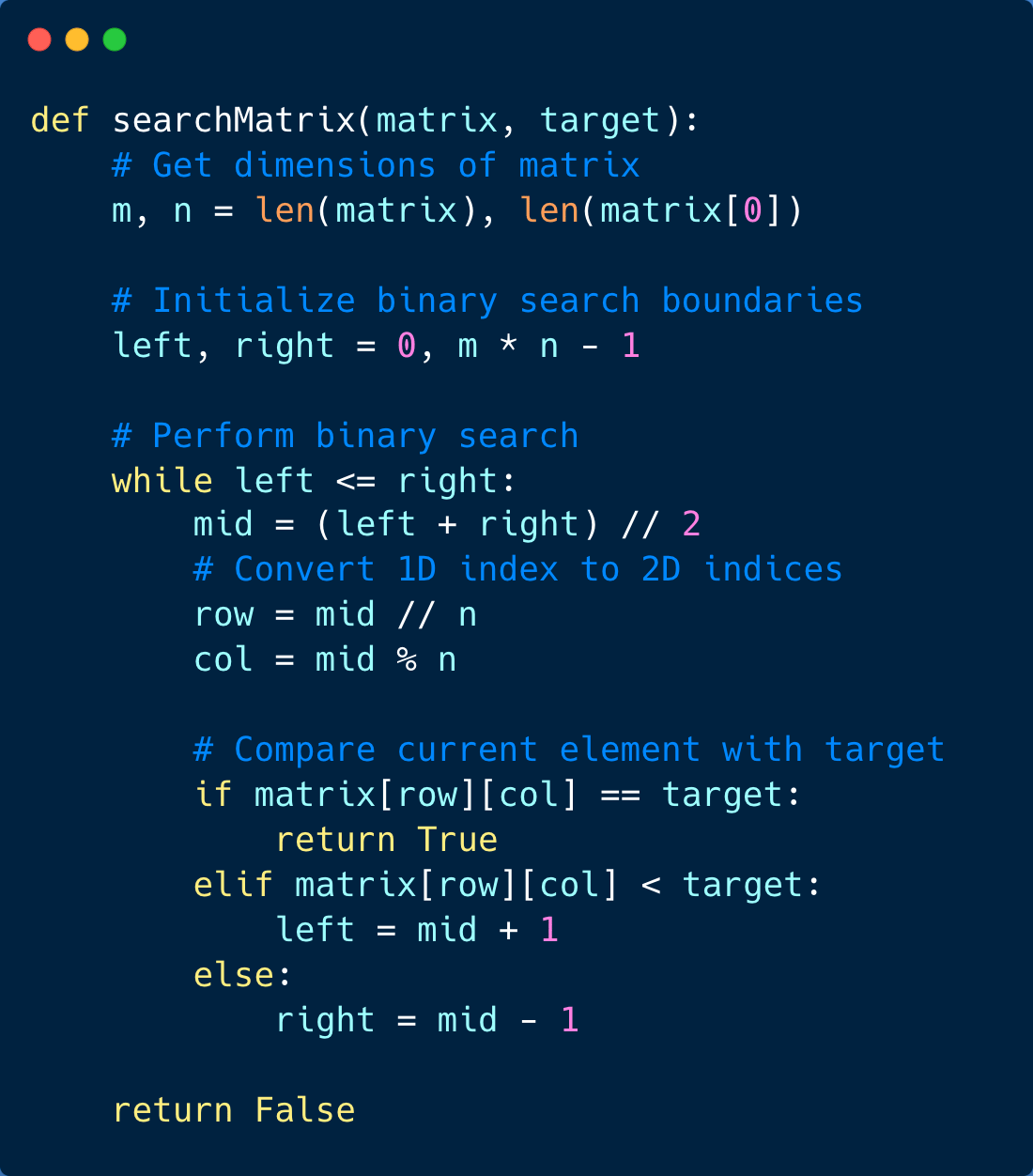
The matrix has special properties where each row is sorted and the first element of each row is greater than the last element of the previous row.
This means that matrix is sorted if you go from top left to bottom right, row by row. So we can treat this 2D matrix as a sorted 1D array and use Binary Search to find the target.
The key is to convert the middle index of binary search into corresponding row and column indices of the matrix.
To convert a 1D index to 2D indices, we can use:
row = index / number of columns
column = index % number of columns
The time complexity of this solution is O(log(m * n)) as we are performing binary search on m * n elements.
TRY PROTON
Free, private email that puts your privacy first

Proton Mail’s free plan keeps your inbox private and secure—no ads, no data mining. Built by privacy experts, it gives you real protection with no strings attached.
SYSTEM DESIGN
Data Partitioning vs Sharding

When your database grows too large to handle efficiently on a single server, you need to split it across multiple servers. This is where data partitioning and sharding come in. While these terms are often used interchangeably, they have some important differences.
Data partitioning is dividing data into smaller, more manageable pieces within the same database instance. Think of an e-commerce database where you partition order data by year. All orders from 2023 go into one partition, 2022 into another, and so on. The database still runs on a single server, but queries can run faster because they only need to look at relevant partitions.
Sharding takes partitioning a step further by spreading these data chunks across different database servers. Each server (called a shard) operates independently and handles its own portion of the data. For example, you might put all orders from North America on one server, European orders on another, and Asian orders on a third.
Sharding provides better scalability since each shard handles fewer requests and stores less data. It also improves availability because if one shard fails, others continue working. However, sharding is more complex to implement and maintain. You need to handle cross-shard queries, manage multiple database connections, and ensure data consistency across shards.
FEATURED COURSES
5 Courses of the Week
✅ DSA in Python: Get hands-on practice with over 100 data structures and algorithm exercises and guidance from a dedicated mentor.
✅ IBM AI Engineering Professional Certificate: Build job-ready AI engineering skills with hands-on projects using TensorFlow, Keras, PyTorch, and Scikit-Learn. Expect to implement machine learning models, build deep learning neural networks, and deploy pipelines on Apache Spark.
✅ Amazon’s Software Developer Certificate: Dive into real-world software development. Expect to create desktop apps with integrated data handling and GUI features. Build a substantial portfolio that demonstrates your technical skills to potential employers.
✅ Microsoft’s Full-Stack Developer Certificate: Learn front-end and back-end development using .NET, C#, Blazor, and Microsoft Copilot. Build complete web apps with focus on security and deployment.
✅ Tools of the Trade: Linux & SQL: Learn essential Linux command line skills and SQL database querying for professionals. This covers file system management, user authentication, and database operations needed for entry-level positions.
HEARD OF 1440?
Tired of news that feels like noise?
Every day, 4.5 million readers turn to 1440 for their factual news fix. We sift through 100+ sources to bring you a complete summary of politics, global events, business, and culture — all in a brief 5-minute email. No spin. No slant. Just clarity.
NEWS
This Week in the Tech World

Anthropic's 'SaaSpocalypse': Claude Cowork plugins wiped $285B off SaaS stocks, hammering Salesforce, Thomson Reuters, and LegalZoom the hardest.
OpenAI Unveils Frontier Platform: New enterprise platform lets companies build and manage AI agents as "digital coworkers." HP, Uber, and State Farm are early adopters.
Anthropic Launches Opus 4.6: New model features multi-agent teams and a 1M-token context window, outperforming OpenAI's GPT-5.2 on professional tasks.
Microsoft Patches 6 Zero-Days: Patch Tuesday fixes 58 flaws including 6 actively exploited zero-days in Windows, Office, and Remote Desktop Services.
Cisco Launches AI Networking Chip: The Silicon One G300 clocks 102.4 Tbps, targeting Nvidia and Broadcom in the AI data center networking race.
EU Launches €2.5B Chip Initiative: The NanoIC pilot line aims to speed next-gen semiconductor development, reducing Europe's dependence on external fabs.
Microsoft Explores Superconducting Cables: High-temp superconducting power lines for AI data centers could deliver equal electricity in a smaller footprint.
BONUS
Just for laughs 😏

HELP US
👋 Hi there! We are on a mission to provide as much value as possible for free. If you want this newsletter to remain free, please help us grow by referring your friends:
📌 Share your referral link on LinkedIn or directly with your friends.
📌 Check your referrals status here.