- InstaByte
- Posts
- Google's AI Brain Drain
Google's AI Brain Drain
ALSO: Throttling and Backpressure

InstaByte
June 24, 2026
In partnership with


Welcome back!
This week, we’ll solve one of the most popular Dynamic Programming problems. Are you ready for the challenge?
Today we will cover:
Longest Increasing Subsequence
Throttling and Backpressure
Read time: under 4 minutes
CODING CHALLENGE
Longest Increasing Subsequence
Given an integer array nums, return the length of the longest strictly increasing subsequence.
Example 1:
Input: nums = [10,9,2,5,3,7,101,18]
Output: 4
Explanation: The longest increasing subsequence is [2,3,7,101], therefore the length is 4.
Example 2:
Input: nums = [0,1,0,3,2,3]
Output: 4
Solve the problem here before reading the solution.
PRESENTED BY NEO
AI help, without the trust tax.
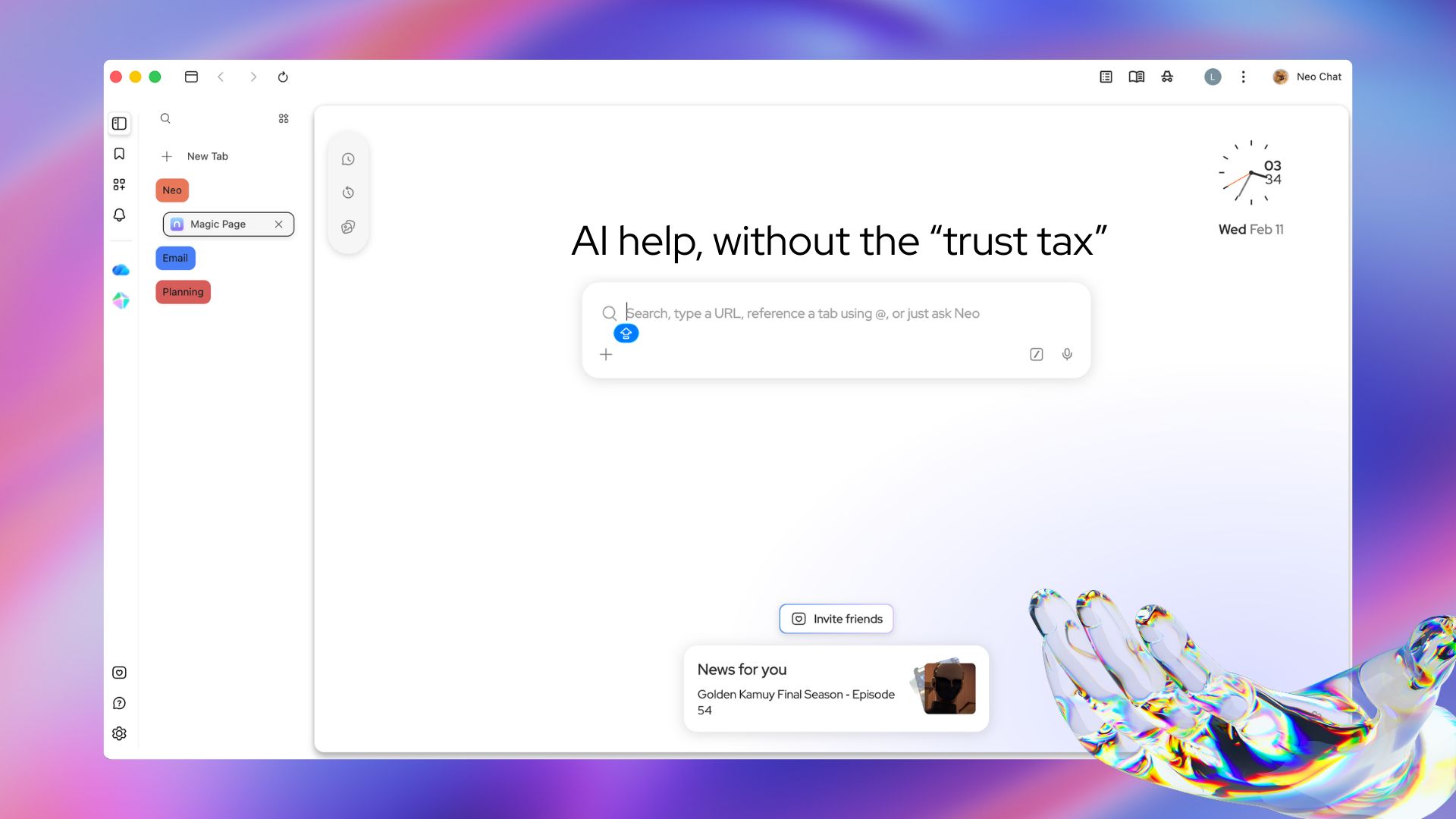
Most AI tools ask you to trade your data for intelligence. Norton Neo doesn't. It's the first safe AI-native browser built by Norton, and it gives you powerful built-in AI without handing your privacy over to get it. Search, summarize, and write with AI built directly into your browser. Your data stays yours. Your context stays private.
Built-in VPN, anti-fingerprinting, and ad blocking come standard. No add-ons. No setup. No compromises.
Fast. Safe. Intelligent. That's Neo.
SOLUTION
To solve this problem efficiently, we'll use dynamic programming with binary search.
The algorithm works as follows:
We start with an empty subsequence array.
We iterate the input array from left to right. For each number, we either:
Append it to the subsequence if it's larger than all existing elements
Replace the smallest element that is greater than or equal to it using binary search
The length of the subsequence array gives us the length of the longest increasing subsequence.
Binary search allows us to efficiently find and replace elements, giving us the O(n log n) time complexity.

HEARD OF WISPR FLOW
Say user_id. Get user_id.

Wispr Flow recognizes variable names, file references, and framework syntax mid-dictation. Speak your prompt, get developer-ready text for GitHub, Jira, or your editor. No mangled syntax. Ever.
SYSTEM DESIGN
Throttling and Backpressure

When systems get overwhelmed with too many requests, they can crash or become unresponsive. This is a common problem in APIs and distributed systems. Throttling and backpressure are two techniques that help prevent system overload.
Throttling limits how many requests a client can make within a specific time period. For example, an API might allow only 100 requests per minute from each user. When a client exceeds this limit, their requests are rejected until the next time window begins. This protects the server from being overwhelmed and ensures fair resource distribution among all clients.
While throttling works by rejecting excess requests, backpressure takes a different approach. Instead of rejection, it slows down the rate at which requests are accepted. Think of water flowing through a pipe. If you pour too fast, water backs up at the entrance. Similarly, backpressure makes the sender slow down when the receiver can't keep up.
Backpressure is especially important in streaming systems where data flows continuously. For example, if a service processing video streams can't keep up with incoming data, it signals the sender to slow down rather than dropping frames or crashing.
There are several ways to implement throttling:
Token bucket: Clients get tokens that replenish over time
Leaky bucket: Requests are processed at a constant rate
Fixed window: Simple counter reset at fixed intervals
Sliding window: More accurate but complex to implement
Backpressure can be implemented through:
Buffer limits: Stop accepting new requests when buffer is full
Flow control: Use protocols that support speed control
Queue monitoring: Adjust accept rate based on queue size
Here's a comparison of both approaches:
Throttling | Backpressure |
|---|---|
Rejects excess requests | Slows down sender |
Simpler to implement | More complex |
Better for API rate limiting | Better for streaming |
Client needs retry logic | Handles overload gracefully |
Works with any protocol | Requires protocol support |
FEATURED COURSES
5 Courses of the Week
✅ Java Programming and Software Engineering Fundamentals Specialization: Build a solid foundation in Java and object-oriented programming through Duke University's acclaimed 5-course series. Develop real software engineering skills by solving practical, project-based problems from day one.
✅ IBM Generative AI for Software Developers Specialization: Learn to integrate generative AI into software applications using LangChain, IBM Watson, and leading LLM APIs. Build hands-on projects that demonstrate practical AI-powered development skills.
✅ Google Business Intelligence Professional Certificate: Launch a BI career with Google's 3-course program covering data modeling, pipelines, and visualization using BigQuery and Looker Studio. Complete portfolio projects that mirror the work real BI professionals do every day.
✅ AWS Data Engineering Professional Certificate: Build and manage production-grade data pipelines on AWS using S3, Glue, Redshift, and Lake Formation. Prepares you for the AWS Certified Data Engineer – Associate exam while you develop hands-on cloud data engineering skills.
✅ Prompt Engineering for ChatGPT: Learn professional prompting techniques from Vanderbilt University that unlock ChatGPT's full potential for writing, coding, and complex problem-solving. A beginner-friendly course that turns everyday AI interactions into powerful productivity workflows.
NEWS
This Week in the Tech World

Google's AI Brain Drain: Alphabet shares fell about 7% after Gemini co-lead and Transformer co-author Noam Shazeer left for OpenAI and Nobel laureate John Jumper exited DeepMind for Anthropic, erasing roughly $250 billion in market cap.
OpenAI Ships Cyber Model: OpenAI released the full GPT-5.5-Cyber, its most capable defensive security model yet, expanding its Daybreak program with a partner network of 25+ security firms and governments plus an open-source patching push with Trail of Bits.
Qualcomm Buys Modular: The chipmaker agreed to acquire AI software startup Modular for about $4 billion in all stock, a 140% markup on its prior $1.6 billion valuation. The bet targets Nvidia's stickiest advantage, its CUDA software moat.
Amazon Drops Altman Biopic: Amazon MGM shelved "Artificial," Luca Guadagnino's nearly finished film about Sam Altman starring Andrew Garfield, saying it would be "better served" elsewhere. The move follows Amazon's $50 billion investment in OpenAI.
Baseten Lands $1.5 Billion: The AI inference startup raised a Series F at up to a $13 billion valuation, more than doubling its prior $5 billion mark. Altimeter, Conviction, and Spark Capital led as demand for cheaper, faster model serving surged.
Huang Puts Security First: At Nvidia's annual meeting, CEO Jensen Huang said "national security comes first," warning that smuggling chips into restricted markets like China is a "dead end" since buyers get no support or repairs for the massive integrated systems.
FERC Fast-Tracks Data Centers: Regulators issued show cause orders to all six US regional grid operators, including PJM and CAISO, giving them 60 days to justify or rewrite the rules governing how AI data centers and other large loads connect to the power grid.
Peregrine Raises $250 Million: The AI public-safety platform closed a Series D at a $6.8 billion valuation, led by Sequoia and Fifth Down Capital. It powers police and government operations and is helping secure the upcoming World Cup as it expands into Toronto and London.
HELP US
👋 Hi there! We are on a mission to provide as much value as possible for free. If you want this newsletter to remain free, please help us grow by referring your friends:
📌 Share your referral link on LinkedIn or directly with your friends.
📌 Check your referrals status here.
BONUS
Just for laughs 😏
