- InstaByte
- Posts
- OpenAI files for IPO
OpenAI files for IPO
ALSO: Load Balancing Algorithms

InstaByte
May 27, 2026
In partnership with


Welcome back!
Let’s solve the Game of Life today! Jokes apart, this is one of the most famous problems asked by FAANGs. Let’s solve it together.
This week, we will cover:
Game of Life
Load Balancing Algorithms
Read time: under 4 minutes
CODING CHALLENGE
Game of Life
According to Wikipedia's article: "The Game of Life, also known simply as Life, is a cellular automaton devised by the British mathematician John Horton Conway in 1970."
The board is made up of an m x n grid of cells, where each cell has an initial state: live (represented by a 1) or dead (represented by a 0). Each cell interacts with its eight neighbors (horizontal, vertical, diagonal) using the following four rules (taken from the above Wikipedia article):
Any live cell with fewer than two live neighbors dies as if caused by under-population.
Any live cell with two or three live neighbors lives on to the next generation.
Any live cell with more than three live neighbors dies, as if by over-population.
Any dead cell with exactly three live neighbors becomes a live cell, as if by reproduction.
The next state of the board is determined by applying the above rules simultaneously to every cell in the current state of the m x n grid board. In this process, births and deaths occur simultaneously.
Given the current state of the board, update the board to reflect its next state.
Note that you do not need to return anything.
Example 1:

Input: board = [[0,1,0],[0,0,1],[1,1,1],[0,0,0]]
Output: [[0,0,0],[1,0,1],[0,1,1],[0,1,0]]
Example 2:

Input: board = [[1,1],[1,0]]
Output: [[1,1],[1,1]]
Solve the problem here before reading the solution.
PRESENTED BY TABS
The Architecture Behind AI-Native Revenue Automation

Most “AI finance” tools guess. Finance can’t. This white paper explains how AI-native revenue automation combines reasoning, deterministic math, and commercial context to automate billing, cash, and close—without sacrificing accuracy. Read the architecture behind AI-native revenue automation.
SOLUTION
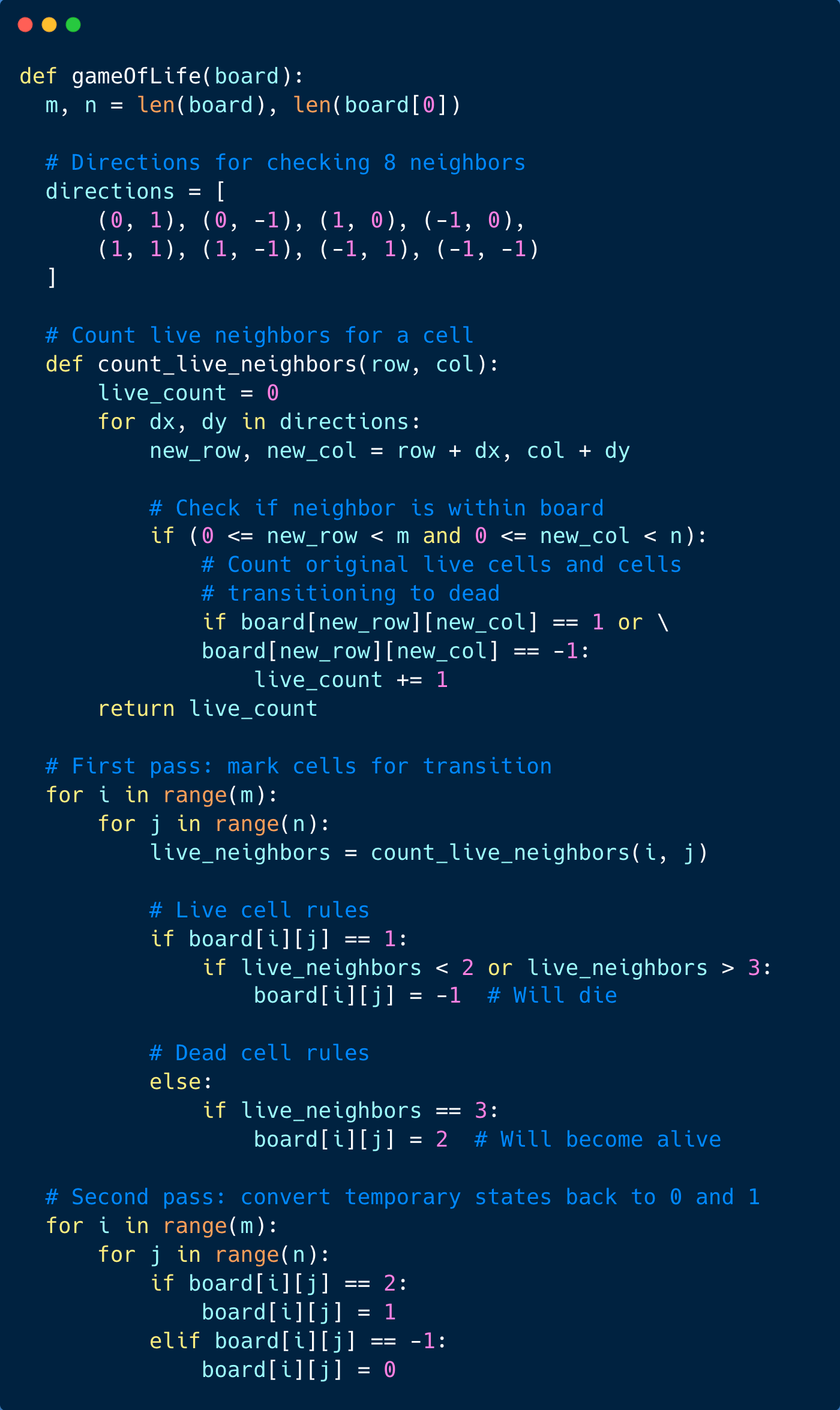
To solve the Game of Life problem, we'll use an in-place modification technique that allows us to track both the current and next state of each cell simultaneously.
We'll introduce two new states to represent the transition:
2 represents a cell that was 0 and will become 1
-1 represents a cell that was 1 and will become 0
This approach allows us to modify the board while preserving the original information needed to determine neighboring cell states.
The algorithm works as follows:
Check each cell's neighbors
Apply the Game of Life rules
Convert the temporary states back to 0 and 1
Time complexity is O(m*n), where m and n are the board dimensions.
Space complexity is O(1) as we modify the board in-place.
HEARD OF MODA?
Moda is the AI design agent with taste.

Your designer is busy. Agencies are expensive. And the deck needs to go out today.
Moda is your AI design partner for the moments when you need great work fast.
Drop in your brand, tell Moda what you need, and get polished, on-brand slides, docs, or ad creative in minutes.
SYSTEM DESIGN
Load Balancing Algorithms

When your website becomes popular and a single server can't handle all the traffic, you need multiple servers to share the load. But how do you decide which request goes to which server? This is where load balancing algorithms come in.
Let's look at the most common load balancing algorithms and understand when to use each one.
Round Robin is the simplest approach. The requests are distributed to servers in a circular order. Server 1 gets the first request, Server 2 gets the second, and so on. When we reach the last server, we start over from Server 1. While simple to implement, Round Robin assumes all servers are equally capable and all requests take similar time to process.
Weighted Round Robin improves on this by assigning weights to servers based on their capacity. A server with weight 2 will receive twice as many requests as a server with weight 1. This works well when you have servers with different processing powers.
Least Connections sends new requests to the server handling the fewest active connections. This is particularly useful when request processing times vary significantly. For example, in an e-commerce site where some users browse quickly while others spend time checking out, Least Connections ensures no server gets overwhelmed.
Least Response Time goes a step further by considering both the number of active connections and the server's response time. This helps identify servers that might be struggling even if they have fewer connections.
IP Hash uses the client's IP address to determine which server should handle the request. This ensures that requests from the same client always go to the same server, which is useful when you need to maintain session data.
FEATURED COURSES
5 Courses of the Week
✅ IBM Full Stack Software Developer Professional Certificate: Launch a career in full-stack development by mastering cloud-native apps with HTML, CSS, JavaScript, React, Node.js, Python, and Docker. Build hands-on projects and earn an industry-recognized credential from IBM.
✅ AI For Everyone: Get a non-technical, business-focused overview of AI from DeepLearning.AI founder Andrew Ng, covering machine learning, neural networks, and AI strategy. Learn how to spot AI opportunities and lead projects in your organization.
✅ Python for Everybody Specialization: Learn Python from the ground up with the University of Michigan's beginner-friendly 5-course series covering data structures, web scraping, databases, and APIs. Finish with a capstone project that ties together everything you've built.
✅ Generative AI with Large Language Models: Go under the hood of modern LLMs with DeepLearning.AI and AWS, covering transformer architectures, prompt engineering, fine-tuning, and RLHF. Apply practical techniques to deploy generative AI applications responsibly.
✅ Google Data Analytics Professional Certificate: Break into a high-demand data analytics career with hands-on training from Google in spreadsheets, SQL, R, and Tableau. Complete a capstone project to showcase your analytical skills to employers.
NEWS
This Week in the Tech World

OpenAI Files for IPO: OpenAI submitted a confidential S-1 draft registration to the SEC, setting up what could be the most anticipated tech debut in years as ChatGPT's lead in the consumer AI race keeps widening.
Anthropic Closes $30B Round: Anthropic is closing a $30B raise at a $900B+ valuation, potentially leapfrogging OpenAI. The company projects Q2 revenue of $10.9B, up 130% from Q1, and its first-ever quarterly operating profit.
Nvidia Posts Record Quarter: Nvidia reported revenue of $81.6B for its fiscal Q1, up 85% year-over-year, with data center sales hitting $75.2B. The chipmaker added $80B to its buyback authorization and raised its quarterly dividend from a penny to 25 cents.
Trump Kills AI Order: The White House shelved a planned AI safety executive order that would have created a 90-day pre-launch model review with NSA involvement, after three tech CEOs called the president directly. Former AI czar David Sacks reportedly hated the draft.
Altman Walks Back Job Warning: OpenAI CEO Sam Altman, speaking in Sydney, admitted he was wrong about AI causing widespread white-collar job losses. He said human interaction is proving harder to replace than he predicted, softening his bleak forecasts.
AI Guardrails Cracked Fast: Researchers stripped safety guardrails off Meta and Google AI models in minutes, the Financial Times reported, unlocking responses on bioweapons, malware, and child exploitation. The findings stoke fresh worries about open-weight model risks.
Google Unveils Fitbit Air: Google launched Fitbit Air, a screenless wearable focused on passive fitness and wellness tracking. Instead of taking on full smartwatches, the device leans into comfort and ambient monitoring, betting users want fewer notifications, not more.
BONUS
Just for laughs 😏

HELP US
👋 Hi there! We are on a mission to provide as much value as possible for free. If you want this newsletter to remain free, please help us grow by referring your friends:
📌 Share your referral link on LinkedIn or directly with your friends.
📌 Check your referrals status here.